Wednesday, May 20, 2009

Quietly Slipping Home.


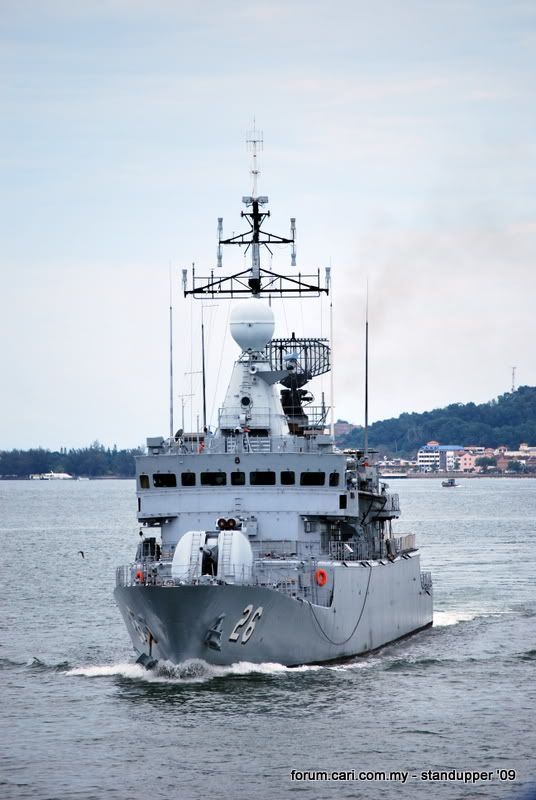
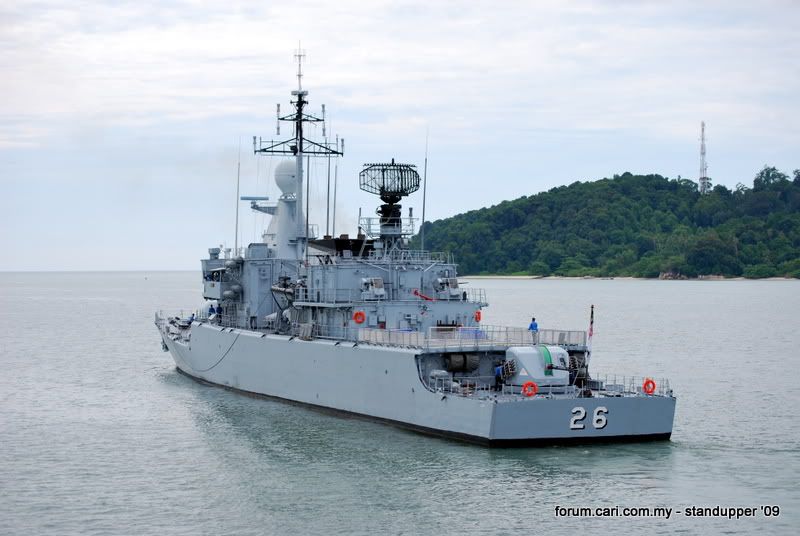
KD Hang Tuah that had just ended their stint in Ops Fajar 3/2009 in the Gulf of Aden had returned to Lumut Naval Base on the 14 of May 2009 without much fanfare and was only reported by a regional Malay newspaper in their articles “Misi iring kapal dagang Negara” and “Operasi Fajar beri pengalaman berharga” last Friday in their Perak State Edition. KD Hang Tuah had departed for Somalia on 4 February 2009 with a crew of 204 and only met with indirect threats from the Somalian pirates although one crewman claimed that they had five confrontations with the pirates. This may be the reason why there was no spotlight on their return despite the fact that KD Hang Tuah had conducted twelve convoy escort missions for 17 merchantmen and 4 tugs during their tour of duty in the Gulf. Now KD Sri Inderapura has left to continue Ops Fajar 4/2009 on the 10th of May, 2009 and if she has a similar quiet mission until she is relieved in June, you can bet that she too will quietly return home although the escot duties is no less important than facing a firefight with the pirates.

Post Edit : 23 May 2009. Sin Chew Chinese Newspaper did make a report, from which article the photo above was taken.

Friday, May 15, 2009

Making A More Permanent Presence?

I had commented in two of my previous postings that the RMN will end their Ops Fajar presence in the Gulf of Aden when KD Hang Tuah ends her deployment at the end of April although there were reports that an Auxilliary Patrol Ship being converted for duties in the Gulf and another ship being readied for further Gulf duties. Today the CNO Admiral Datuk Seri Abdul Aziz Jaafar finally had confirmed in a local Malay newspaper report that Ops Fajar has been further continued by the despatch of KD Inderapura for a two month deployment until the end of June.
Nonetheless the more interesting bit of news from the report is the fact that the CNO further mentioned that KD Inderapura tour of duty will be continued by an "auxiliary ship" the name of which the report says the CNO did not want to state. In page 6 of today's Berita Harian however, a small article that did not make it into the internet edition headlined "Kapal Khas Pantau Lanun" or 'Special Ship to Monitor Pirates', more details can discerned about the auxilliary ship that will be operational after Ops Fajar ends in June to monitor our nation's merchantment voyages in the Gulf. It was stated that the converted ship will become a platform for monitoring platform in the Gulf waters. The RMN will put on board the ship a crew of RMN men and support forces that will be rotated after a certain period of time. The ship itself will be in the Gulf water for a long period of time. This indicates to me that the RMN now intends to make their presence more permanent, and by using an auxilliary ship rather than a full fledged warship, will provide a more sensitive presence that is less militaristic in nature in the Gulf while allowing the Navy to not detach a unit from their fleet that may now face a hotter situation in the national waters if the Spratlys issue takes a turn for the worse. Whatever it is I cannot help but wonder whether this auxilliary ship that is undergoing conversion is this ship snapped by a blogger while travelling past Lumut Naval base that was posted on her site. Interesting speculation it does make, doesn't it.

Tuesday, May 12, 2009

Historical Photos Liberated - HMMS Pelandok


I have written about HMMS Sri Perlis or more well known as HMMS Pelandok that served as one of the earliest vessels in the nucleus force of the Royal Malaysian Navy under The Malaysian Naval Force. She was a LCG (L) equipped with two 4.7 inch guns that was used as a bombardment vessel during the first Emergency that Malaysia faced in addition to sea going training ship. The problem is that not many people may have seen photos of these brave men in action as I have found that the photos can only be more easily found in the archives of our neigbouring country. Thus in the interest of bringing these historical photos to a wider section of public, I will from time to time post liberated photos from these foreign archives, with the hope that their memory will be better preserved and more accessible than just gathering dust until some academician soul stumble across them, the most likely scenario in our own National Archives.

1. HMMS Pelandok Gun Crew


Notes : Last 2 Photos contributed by Daniel Spence, Sheffield Hallam University

2. Ship Visits


3. The End?


Edited 28 June 2009.

Saturday, May 9, 2009

Royal Malaysian Navy - Offshore EEZ Stations

For the Malaysians in the peninsular at least, Lumut would be THE Navy town where the premier Royal Malaysian Navy base is located. Thus many would not be aware that Sepanggar Bay at Kota Kinabalu in Sabah would become another premier naval base where the Command Naval Area 2 or COMNAV 2 is located after being transferred from KD Sri Labuan. This is where our submarines will be based and under COMNAV 3 also there are many units that you can read all about at the COMNAV2 website, though currently only available in English, including the Kuching Representative Naval Office (RNO/PWTL) and KD Sri Rejang in Sibu. This post however would concentrate on an isolated area of operations for the RMN, that is the naval stations in the Gugusan Semarang Peninjau that after the declaration of the Economic Exclusive Zone (EEZ) on 20 September 1979, have become outposts to validate Malaysia’s claims to the areas under the EEZ that are at least 156 nautical miles away from Kota Kinabalu.

Comprising five stations originally built on outlaying atolls, with the most developed now expanded to a full fledged island that is now a popular diving spot in the region. This is in contrast from the origins of Layang-Layang Island when the island started to receive its first human population three years after a claim plaque was erected on the coral atoll. It was at the time on 21 June 1980, when eighteen hardy Paskal men went ashore on May 1983 to build the first encampment while braving the elements. This place is called Wisma Kaki Langit because at the time the only infrastructure available was a helipad for personnel transfer and the soldiers had to camp under the open skies on the bare reef. When the naval station proper was constructed six years later with the construction of a small living-cum-operations quarters, it was also decided that the enlarged island the atoll has become will also be developed as a tourist attraction so that the tourism potential of the island can be exploited. Thus by 1995, more buildings were added, including two air-conditioned accommodation blocks, an aircraft landing strip, which can be used by Hercules C-130 and CN235 aircraft, two hangars, a radar station, an air traffic control tower, watchtowers and a jetty has made the island a proper island station code named Station Lima for the naval men stationed there to safeguard our nation’s claim to the area. Patrols by navy soldiers in CB90H attack vessels and larger, faster patrol boats are carried out around the island. Several anti-ship and anti-aircraft guns are placed on several areas on the island and the RMAF personnel operate a Starburst air defence system to prevent low-level air attacks here.

Ubi Reef or Station Uniform was one of the stations which construction was started in the mid-80s for the purpose of monitoring and protection the territorial waters in international boundaries. It was built in early 1986 by Malaysian Shipping Engineering Corporation and in its early stage, was only a module built on top of a barge measuring 60 metres long and 30 metres wide anchored on top of Ubi Reef(Ardasier Reef) that is supposed to be the largest reef in Gugusan Semarang Peninjau. The station was officialy opended on 16 April 1986 and is located 16 nautical miles to the south west of Station Lima and 25 miles south of Station Mike. In 2000 the station was enlarged by filling in around the lagoon basin and a channel was built for safe passage of the visiting navy CB90 Combat Boat to enter and dock at the station. A beacon was also built about one mile to the east of the station to mark guide the boats into the lagoon. A buoy was also placed in the middle of the lagoon to assist in the berthing of the boats. In general, Station Uniform assets has been much enhanced to increase the operational readiness of the station.

The next reef to be populated was Station Mike or Mantanani Reef when a habitat module built by Malaysian Shipping Engineering Corporation was anchored onto the reef in the middle of September 1986 and was officially opened three months later. The 44 metre long Station Mike is located about 35 nautical miles to the north of Station Lima and is close to a Vietnamese settlement on Amboyna Cay only 40 nautical miles away. On 18 May 1994, the area around the islet was however declared a restricted area possibly due to its close proximity to competing forces.

The founding history of Station Sierra or Siput Reef started with the construction on a barge type module at Jerjak Island by PSCND. The module was specially designed originally as a floating vessel to facilitate towing at sea before it is anchored at Siput Reef. The towing was carried out in April 1999 codenamed Ops Sri Petaling whereby the module was towed under the element of disguise to avert notice by neighbouring countries in an operation taking almost one month. The sailing and towing operations was undertaken with several RMN ships in escort until reaching the site and anchored about 16 nautical miles south west of Station Mike. Location selection and module positioning was done during high tide so that it can be more easily anchored during low tide and after found satisfactory, the module was landed and filled in with cement and rocks to strengthen its anchorage. These works were completed in early May 1999 and officially named on 10 May 1999. In its early operations, it was declared that the module was built for marine and scientific research to reduce pressure and misunderstanding by claimant nations. The station was further secured by the extension of Ops Sri Petaling for monitoring and defence in order to safeguard the station from any threats especially from nations objecting to Malaysia’s settlement on the islet.

Similarly Station Papa was also constructed by PSCND that was originally a module built on top of a large barge that was towed to its current site in the same Ops Sri Petaling in early April 1999 before being anchored in the middle of Peninjau reef and located 70 miles north east of Station Lima. Work on anchoring the module on the largest reef in amongst the station was completed and then officially opened on 10 May 1999. Station Papa was similarly declared as a maritime scientific research station to reduce claimants’ pressure and similarly secured like Station Sierra against any threats from competing claimants.

The presence of soldiers on the islets demonstrates the sensitivity of the situation involving the overlapping claims on the many islands within the Spratlys archipelago. Military personnel are needed to maintain Malaysia’s control of the islets and also to protect the rich marine life surrounding it. The islands are important strategic assets for the country and were believed to contain natural resources such as oil, phosphorous and natural gas. Meanwhile, the reefs are teeming with a beautiful and diverse marine life such as corals and many types of fish, which are great tourist attractions. The soldiers are entrusted with the task of ensuring that only fishing vessels with permits are allowed into the area and fishermen cannot catch legally-protected fish. They also make patrols to prevent intrusions by foreign fishing boats or other types of vessels into the territorial waters. Men stationed at the five islets normally on a three-month rotation monitor the movement of foreign ships and aircraft in the area, including military submarines that constantly ply the South China Sea and every incident of close encounters with foreign ships and aircraft are logged although no incident or confrontation has been officially reported. A trivia about these islets is that has been honoured with a stamp series featuring their ecological systems. Yet these offshore EEZ bases mark our frontiers out in the South China Sea, unprotected from the vagrancies of weather and atrocious sea conditions! Cold and distant these sovereign territorial positions are guarded around the clock by RMN personnel, whilst our citizens are safely tucked in the peace and security of their homes.

Thursday, April 23, 2009

Making New Out Of Old

According to the Dictionary of Naval Terms by Thomas J Cutler, a service life extension program is a program designed to extend the period of usefulness of service vessels by giving them an extensive overhaul and modernization refit. This is where the life of the hull and basic structure of a ship is extended by replacing the mechanical, electrical, propulsion, waste, and other systems and likely rebuilding the spaces and, of course, re-outfitting them. Nonetheless it has to be remembered that the lifetime of the refitted (SLEP) ship will likely be less than that of a new ship. Although almost all navies does this procedure, unfortunately for a small navy like ours with limited resources, SLEP has been a way to prolong the life of our naval assets as replacements are usually far in between and may not even be insufficient quantities. For example, our FS1500 Kasturi class frigates has since 1984 had refits under SLEP when their Sewaco combat system wasa updated 1999 and later refits, the 100 mm gun was upgraded to Mk2 configuration in 1994 and around 2002 their MM38 Exocet SSM replaced with the newer MM40 version. As reported by a journalist who attended the recent RMN media event, KD Lekir the second in the class has just finished her SLEP program but there seems to be no identifiable changes to her appearance to suggest a major modernisation refit was undertaken as shown by the photographs here.


This was despite the announcement during LIMA 2007 that the government had handed over the letter of intent (LOI) to Boustead Naval Shipyard Sdn Bhd for service life extension program of Kasturi Class Corvettes for both KD Kasturi and KD Lekir of RMN. Nonetheless the exclusive photo above taken by Cari Forum Member Standupper on 15 April that was posted in the Security Agencies, Police and Military discussion board shows that the hull of KD Kasturi being completely gutted, probably in anticipation of the full modernisation announced in the LOI. Another source has advised that KD Kasturi entered the dockyard at the end of last year and only recently was prepared for the SLEP program. This modernisation is expected to consist of the following upgrade package as reported by Tempur defence magazine previously :

a. Installation of TACTICOS CMS to replace the Daisy Sewaco-MA Combat Data System

b. Electronics package including Thales DA-08 air search radar , Mirador-IR optronic director,
marine navigation radar , DR3000S ESM suite, ATLAS Electronik DSQS-24C hull mounted sonar, Link Y MK 2.5 and TERMA SKWS decoys.

c. Weapons system upgrade with the intallation of a Eurotorp B515 with A244S Whitehead ASW torpedoes at the ASRL position, the 100 mm gun would be replaced with a medium calibre gun , most probably with the existing Bofors 57 mm gun as the aft gun would be removed completely in order to extend the helicopter deck and two MSI 30 mm guns would replace the existing Emerlec guns.

Well we can only wait and hope that the modernisation upgrade as speculated above be carried out after the ship has finished her SLEP as otherwise her mission capability may not be sufficient to increase her survivability in the this more challenging environment as compared to when she was built in the 1980's. This is especially since we cannot afford to buy many new fighting platforms but instead have to rely on making new out of old ships that we already have.

Saturday, April 18, 2009

Return Of The Armed Merchantman?

KL Security Review has reported that the Malaysian Navy confirmed that the Royal Malaysian Navy and Malaysian International Shipping Corporation(MISC) is negotiating to cooperate in upgrading a merchant ship to become a naval auxiliary ship to replace the navy ships deployment in the Gulf of Aden Bay for escort missions. Off hand this piece of news brings to mind the gallant armed merchantmen that served as the cradle and crucible to forge the Malay navy men during World War II with heroic gallantry and which now lends their names to the Navy's own patrol vessels. That was a time when navy combat ships were in scarce supply thus these merchantmen had to be armed as naval auxiliary ships to conduct patrol and escort missions. It seems now that our own navy can no longer afford to spare a navy unit to undertake the convoy escort missions and thus has to request MISC to furnish them with a naval auxiliary to undertake such missions.

The report stated that a merchant ship have been identified for the conversion and the ship selected merchant must comply with several conditions, for example, must have space for a hangar and accommodation for naval staff on the ship. The article also stated that MISC already operates vessels with helipads in their Offshore Floating Facilities fleet, but what they may have not realised are that such ships are tethered production and storage vessels, and the helipad conversions they have installed may not be suitable for a vessel that is supposed to be sailing in speed and in climatically challenging environment as can be seen from these photos of the various vessels. In fact if we are to peruse MISC's fleet, it may not make much sense to convert their ships just to ply the Gulf for escort duties without any payload, especially for only one unit and it also does not make sense commercially to convert several units for such a role just because modern ship designs just do not lend itself easily for conversion to armed merchantmen. In addition, the current modus operandi for the convoys is for our merchant ships to muster at a friendly port like Djibouti before transiting the Gulf under armed naval escort. Thus the period when the escort ship returns to a port of muster to berth and wait for the next convoy to form up means idle time for a merchant ship, and I believe would be a sticking point between the Navy and MISC. Another factor would be the crewing of the ship, as navy sailors may not be able to or cannot crew such a merchant men, and I doubt if civilian crews would want to endure such a task like convoy duties in the Gulf that some of our navy men from Ops Fajar has stated is a harrowing task.

So what should be the better solution in the humble opinion of this blogger you say? Well in this case I would like to remind you that the RMN are actually no strangers to operating leased commercial vessels in their fleet like MV Fajar Samudera, MV Mahsuri and STS Puteri Mahsuri in addition to commercial hydrographic vessels. The first two ships are being used to train their sailors including reservists. As the sending of KD Tuah has set a precedent of sending trainee sailors to the Gulf area of operations, then I do not see any reason why we should not send any of these two training vessels instead. MV Fajar Samudera on the left is more like a cruise ship to be a good naval deterrent while MV Mahsuri on the right is a 92 metre long 4000 tonnes ex-research vessel with a cruising speed of 12.5 knots, perfect for such convoy escort work. In addition, the ship design already incorporates a large helicopter pad in the stern and since it is a training ship, accommodation should not be a problem for the navy Special Forces men assigned to her. She also has a stern ramp for easy deployment of the Special Forces men and also has medical facilities on board and has served as a hospital ship during the Navy's exercises. Thus the conversion required for MV Mahsuri can be no more than installing non deck penetration medium calibre guns and repainting the ship to naval grey to show it means business. It fact this ship approximates most closely the size and capability of KD Mahawangsa and KD Inderasakti that has done their tour of duty in the Gulf.

The only problem this idea would face is that MV Mahsuri is currently privately owned and crewed by civilians under the command of the Navy. But then this should not be too difficult to resolve as there is already a precedent for our oil industry players to supply equipment for the Navy's Paskal for use in their oil platform protection duties. So why not our shipping industry players led by MISC then not buy over the ship and present it to the navy for use in the escort missions, or at least lease the ship on the navy's behalf for the navy to operate. If the MV Mahsuri is not available, then I am sure in the current state of shipping industry that is in the doldrums, it would be easy to find another suitable or much better ship to undertake the task. Would RFA Argus or its Chinese equivalent Shicang class be too much too ask?

Wednesday, April 15, 2009

KD Hang Tuah To Return Month End


KL Security Review has reported that KD Hang Tuah's deployment in the Gulf Of Aden will end at the end of the month. And I speculated wrongly in my previous post that this would deprive the navy trainees from on board training, as KLSR has reported that the trainees are actually deployed on this voyage with the main benefit is to allow the trainee officers to carry out its mandate to study ocean-going training and experience. This is a good strategy by the RMN to utilise the funding for this voyage to also provide ocean going to the trainee officer, which due to lack of resources the Navy rarely emulates the major navies' midshipmen training ship round the world voyages. Nice going! You guys are really stretching the dollar for the good of the Navy.

Post Script

From a newspaper article that appears on the day after this posting was made, the RMN CNO was quoted as saying that Ops Fajar was to be terminated due to the economic slump that is happening whereby fewer merchant ships are moving in the danger area. The high cost of monitoring and escorting the merchant ships through the Gulf that is fully borne by the Navy was another factor in the decision to terminate the operations.