Tuesday, May 12, 2009

Historical Photos Liberated - HMMS Pelandok


I have written about HMMS Sri Perlis or more well known as HMMS Pelandok that served as one of the earliest vessels in the nucleus force of the Royal Malaysian Navy under The Malaysian Naval Force. She was a LCG (L) equipped with two 4.7 inch guns that was used as a bombardment vessel during the first Emergency that Malaysia faced in addition to sea going training ship. The problem is that not many people may have seen photos of these brave men in action as I have found that the photos can only be more easily found in the archives of our neigbouring country. Thus in the interest of bringing these historical photos to a wider section of public, I will from time to time post liberated photos from these foreign archives, with the hope that their memory will be better preserved and more accessible than just gathering dust until some academician soul stumble across them, the most likely scenario in our own National Archives.

1. HMMS Pelandok Gun Crew


Notes : Last 2 Photos contributed by Daniel Spence, Sheffield Hallam University

2. Ship Visits


3. The End?


Edited 28 June 2009.

Saturday, May 9, 2009

Royal Malaysian Navy - Offshore EEZ Stations

For the Malaysians in the peninsular at least, Lumut would be THE Navy town where the premier Royal Malaysian Navy base is located. Thus many would not be aware that Sepanggar Bay at Kota Kinabalu in Sabah would become another premier naval base where the Command Naval Area 2 or COMNAV 2 is located after being transferred from KD Sri Labuan. This is where our submarines will be based and under COMNAV 3 also there are many units that you can read all about at the COMNAV2 website, though currently only available in English, including the Kuching Representative Naval Office (RNO/PWTL) and KD Sri Rejang in Sibu. This post however would concentrate on an isolated area of operations for the RMN, that is the naval stations in the Gugusan Semarang Peninjau that after the declaration of the Economic Exclusive Zone (EEZ) on 20 September 1979, have become outposts to validate Malaysia’s claims to the areas under the EEZ that are at least 156 nautical miles away from Kota Kinabalu.

Comprising five stations originally built on outlaying atolls, with the most developed now expanded to a full fledged island that is now a popular diving spot in the region. This is in contrast from the origins of Layang-Layang Island when the island started to receive its first human population three years after a claim plaque was erected on the coral atoll. It was at the time on 21 June 1980, when eighteen hardy Paskal men went ashore on May 1983 to build the first encampment while braving the elements. This place is called Wisma Kaki Langit because at the time the only infrastructure available was a helipad for personnel transfer and the soldiers had to camp under the open skies on the bare reef. When the naval station proper was constructed six years later with the construction of a small living-cum-operations quarters, it was also decided that the enlarged island the atoll has become will also be developed as a tourist attraction so that the tourism potential of the island can be exploited. Thus by 1995, more buildings were added, including two air-conditioned accommodation blocks, an aircraft landing strip, which can be used by Hercules C-130 and CN235 aircraft, two hangars, a radar station, an air traffic control tower, watchtowers and a jetty has made the island a proper island station code named Station Lima for the naval men stationed there to safeguard our nation’s claim to the area. Patrols by navy soldiers in CB90H attack vessels and larger, faster patrol boats are carried out around the island. Several anti-ship and anti-aircraft guns are placed on several areas on the island and the RMAF personnel operate a Starburst air defence system to prevent low-level air attacks here.

Ubi Reef or Station Uniform was one of the stations which construction was started in the mid-80s for the purpose of monitoring and protection the territorial waters in international boundaries. It was built in early 1986 by Malaysian Shipping Engineering Corporation and in its early stage, was only a module built on top of a barge measuring 60 metres long and 30 metres wide anchored on top of Ubi Reef(Ardasier Reef) that is supposed to be the largest reef in Gugusan Semarang Peninjau. The station was officialy opended on 16 April 1986 and is located 16 nautical miles to the south west of Station Lima and 25 miles south of Station Mike. In 2000 the station was enlarged by filling in around the lagoon basin and a channel was built for safe passage of the visiting navy CB90 Combat Boat to enter and dock at the station. A beacon was also built about one mile to the east of the station to mark guide the boats into the lagoon. A buoy was also placed in the middle of the lagoon to assist in the berthing of the boats. In general, Station Uniform assets has been much enhanced to increase the operational readiness of the station.

The next reef to be populated was Station Mike or Mantanani Reef when a habitat module built by Malaysian Shipping Engineering Corporation was anchored onto the reef in the middle of September 1986 and was officially opened three months later. The 44 metre long Station Mike is located about 35 nautical miles to the north of Station Lima and is close to a Vietnamese settlement on Amboyna Cay only 40 nautical miles away. On 18 May 1994, the area around the islet was however declared a restricted area possibly due to its close proximity to competing forces.

The founding history of Station Sierra or Siput Reef started with the construction on a barge type module at Jerjak Island by PSCND. The module was specially designed originally as a floating vessel to facilitate towing at sea before it is anchored at Siput Reef. The towing was carried out in April 1999 codenamed Ops Sri Petaling whereby the module was towed under the element of disguise to avert notice by neighbouring countries in an operation taking almost one month. The sailing and towing operations was undertaken with several RMN ships in escort until reaching the site and anchored about 16 nautical miles south west of Station Mike. Location selection and module positioning was done during high tide so that it can be more easily anchored during low tide and after found satisfactory, the module was landed and filled in with cement and rocks to strengthen its anchorage. These works were completed in early May 1999 and officially named on 10 May 1999. In its early operations, it was declared that the module was built for marine and scientific research to reduce pressure and misunderstanding by claimant nations. The station was further secured by the extension of Ops Sri Petaling for monitoring and defence in order to safeguard the station from any threats especially from nations objecting to Malaysia’s settlement on the islet.

Similarly Station Papa was also constructed by PSCND that was originally a module built on top of a large barge that was towed to its current site in the same Ops Sri Petaling in early April 1999 before being anchored in the middle of Peninjau reef and located 70 miles north east of Station Lima. Work on anchoring the module on the largest reef in amongst the station was completed and then officially opened on 10 May 1999. Station Papa was similarly declared as a maritime scientific research station to reduce claimants’ pressure and similarly secured like Station Sierra against any threats from competing claimants.

The presence of soldiers on the islets demonstrates the sensitivity of the situation involving the overlapping claims on the many islands within the Spratlys archipelago. Military personnel are needed to maintain Malaysia’s control of the islets and also to protect the rich marine life surrounding it. The islands are important strategic assets for the country and were believed to contain natural resources such as oil, phosphorous and natural gas. Meanwhile, the reefs are teeming with a beautiful and diverse marine life such as corals and many types of fish, which are great tourist attractions. The soldiers are entrusted with the task of ensuring that only fishing vessels with permits are allowed into the area and fishermen cannot catch legally-protected fish. They also make patrols to prevent intrusions by foreign fishing boats or other types of vessels into the territorial waters. Men stationed at the five islets normally on a three-month rotation monitor the movement of foreign ships and aircraft in the area, including military submarines that constantly ply the South China Sea and every incident of close encounters with foreign ships and aircraft are logged although no incident or confrontation has been officially reported. A trivia about these islets is that has been honoured with a stamp series featuring their ecological systems. Yet these offshore EEZ bases mark our frontiers out in the South China Sea, unprotected from the vagrancies of weather and atrocious sea conditions! Cold and distant these sovereign territorial positions are guarded around the clock by RMN personnel, whilst our citizens are safely tucked in the peace and security of their homes.

Thursday, April 23, 2009

Making New Out Of Old

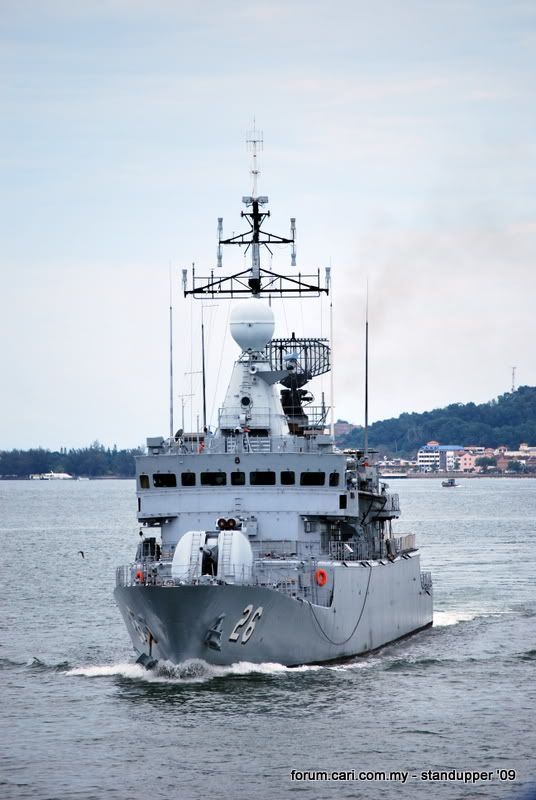
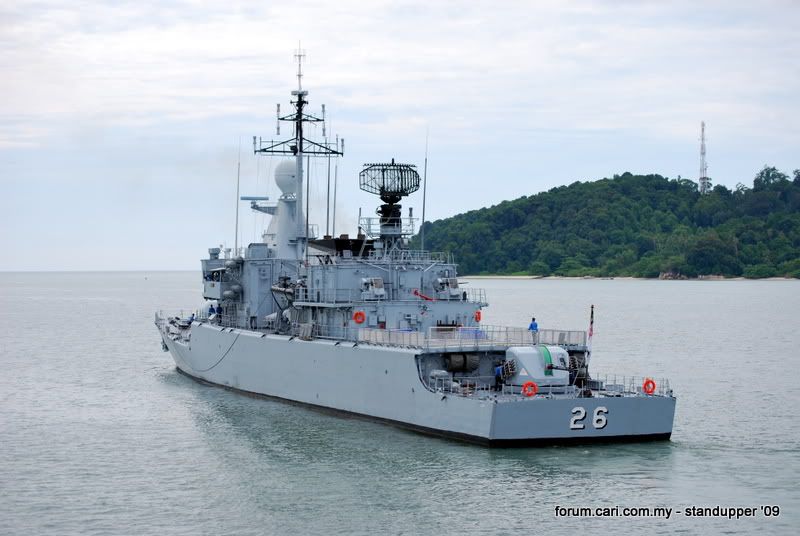
According to the Dictionary of Naval Terms by Thomas J Cutler, a service life extension program is a program designed to extend the period of usefulness of service vessels by giving them an extensive overhaul and modernization refit. This is where the life of the hull and basic structure of a ship is extended by replacing the mechanical, electrical, propulsion, waste, and other systems and likely rebuilding the spaces and, of course, re-outfitting them. Nonetheless it has to be remembered that the lifetime of the refitted (SLEP) ship will likely be less than that of a new ship. Although almost all navies does this procedure, unfortunately for a small navy like ours with limited resources, SLEP has been a way to prolong the life of our naval assets as replacements are usually far in between and may not even be insufficient quantities. For example, our FS1500 Kasturi class frigates has since 1984 had refits under SLEP when their Sewaco combat system wasa updated 1999 and later refits, the 100 mm gun was upgraded to Mk2 configuration in 1994 and around 2002 their MM38 Exocet SSM replaced with the newer MM40 version. As reported by a journalist who attended the recent RMN media event, KD Lekir the second in the class has just finished her SLEP program but there seems to be no identifiable changes to her appearance to suggest a major modernisation refit was undertaken as shown by the photographs here.


This was despite the announcement during LIMA 2007 that the government had handed over the letter of intent (LOI) to Boustead Naval Shipyard Sdn Bhd for service life extension program of Kasturi Class Corvettes for both KD Kasturi and KD Lekir of RMN. Nonetheless the exclusive photo above taken by Cari Forum Member Standupper on 15 April that was posted in the Security Agencies, Police and Military discussion board shows that the hull of KD Kasturi being completely gutted, probably in anticipation of the full modernisation announced in the LOI. Another source has advised that KD Kasturi entered the dockyard at the end of last year and only recently was prepared for the SLEP program. This modernisation is expected to consist of the following upgrade package as reported by Tempur defence magazine previously :

a. Installation of TACTICOS CMS to replace the Daisy Sewaco-MA Combat Data System

b. Electronics package including Thales DA-08 air search radar , Mirador-IR optronic director,
marine navigation radar , DR3000S ESM suite, ATLAS Electronik DSQS-24C hull mounted sonar, Link Y MK 2.5 and TERMA SKWS decoys.

c. Weapons system upgrade with the intallation of a Eurotorp B515 with A244S Whitehead ASW torpedoes at the ASRL position, the 100 mm gun would be replaced with a medium calibre gun , most probably with the existing Bofors 57 mm gun as the aft gun would be removed completely in order to extend the helicopter deck and two MSI 30 mm guns would replace the existing Emerlec guns.

Well we can only wait and hope that the modernisation upgrade as speculated above be carried out after the ship has finished her SLEP as otherwise her mission capability may not be sufficient to increase her survivability in the this more challenging environment as compared to when she was built in the 1980's. This is especially since we cannot afford to buy many new fighting platforms but instead have to rely on making new out of old ships that we already have.

Saturday, April 18, 2009

Return Of The Armed Merchantman?

KL Security Review has reported that the Malaysian Navy confirmed that the Royal Malaysian Navy and Malaysian International Shipping Corporation(MISC) is negotiating to cooperate in upgrading a merchant ship to become a naval auxiliary ship to replace the navy ships deployment in the Gulf of Aden Bay for escort missions. Off hand this piece of news brings to mind the gallant armed merchantmen that served as the cradle and crucible to forge the Malay navy men during World War II with heroic gallantry and which now lends their names to the Navy's own patrol vessels. That was a time when navy combat ships were in scarce supply thus these merchantmen had to be armed as naval auxiliary ships to conduct patrol and escort missions. It seems now that our own navy can no longer afford to spare a navy unit to undertake the convoy escort missions and thus has to request MISC to furnish them with a naval auxiliary to undertake such missions.

The report stated that a merchant ship have been identified for the conversion and the ship selected merchant must comply with several conditions, for example, must have space for a hangar and accommodation for naval staff on the ship. The article also stated that MISC already operates vessels with helipads in their Offshore Floating Facilities fleet, but what they may have not realised are that such ships are tethered production and storage vessels, and the helipad conversions they have installed may not be suitable for a vessel that is supposed to be sailing in speed and in climatically challenging environment as can be seen from these photos of the various vessels. In fact if we are to peruse MISC's fleet, it may not make much sense to convert their ships just to ply the Gulf for escort duties without any payload, especially for only one unit and it also does not make sense commercially to convert several units for such a role just because modern ship designs just do not lend itself easily for conversion to armed merchantmen. In addition, the current modus operandi for the convoys is for our merchant ships to muster at a friendly port like Djibouti before transiting the Gulf under armed naval escort. Thus the period when the escort ship returns to a port of muster to berth and wait for the next convoy to form up means idle time for a merchant ship, and I believe would be a sticking point between the Navy and MISC. Another factor would be the crewing of the ship, as navy sailors may not be able to or cannot crew such a merchant men, and I doubt if civilian crews would want to endure such a task like convoy duties in the Gulf that some of our navy men from Ops Fajar has stated is a harrowing task.

So what should be the better solution in the humble opinion of this blogger you say? Well in this case I would like to remind you that the RMN are actually no strangers to operating leased commercial vessels in their fleet like MV Fajar Samudera, MV Mahsuri and STS Puteri Mahsuri in addition to commercial hydrographic vessels. The first two ships are being used to train their sailors including reservists. As the sending of KD Tuah has set a precedent of sending trainee sailors to the Gulf area of operations, then I do not see any reason why we should not send any of these two training vessels instead. MV Fajar Samudera on the left is more like a cruise ship to be a good naval deterrent while MV Mahsuri on the right is a 92 metre long 4000 tonnes ex-research vessel with a cruising speed of 12.5 knots, perfect for such convoy escort work. In addition, the ship design already incorporates a large helicopter pad in the stern and since it is a training ship, accommodation should not be a problem for the navy Special Forces men assigned to her. She also has a stern ramp for easy deployment of the Special Forces men and also has medical facilities on board and has served as a hospital ship during the Navy's exercises. Thus the conversion required for MV Mahsuri can be no more than installing non deck penetration medium calibre guns and repainting the ship to naval grey to show it means business. It fact this ship approximates most closely the size and capability of KD Mahawangsa and KD Inderasakti that has done their tour of duty in the Gulf.

The only problem this idea would face is that MV Mahsuri is currently privately owned and crewed by civilians under the command of the Navy. But then this should not be too difficult to resolve as there is already a precedent for our oil industry players to supply equipment for the Navy's Paskal for use in their oil platform protection duties. So why not our shipping industry players led by MISC then not buy over the ship and present it to the navy for use in the escort missions, or at least lease the ship on the navy's behalf for the navy to operate. If the MV Mahsuri is not available, then I am sure in the current state of shipping industry that is in the doldrums, it would be easy to find another suitable or much better ship to undertake the task. Would RFA Argus or its Chinese equivalent Shicang class be too much too ask?

Wednesday, April 15, 2009

KD Hang Tuah To Return Month End


KL Security Review has reported that KD Hang Tuah's deployment in the Gulf Of Aden will end at the end of the month. And I speculated wrongly in my previous post that this would deprive the navy trainees from on board training, as KLSR has reported that the trainees are actually deployed on this voyage with the main benefit is to allow the trainee officers to carry out its mandate to study ocean-going training and experience. This is a good strategy by the RMN to utilise the funding for this voyage to also provide ocean going to the trainee officer, which due to lack of resources the Navy rarely emulates the major navies' midshipmen training ship round the world voyages. Nice going! You guys are really stretching the dollar for the good of the Navy.

Post Script

From a newspaper article that appears on the day after this posting was made, the RMN CNO was quoted as saying that Ops Fajar was to be terminated due to the economic slump that is happening whereby fewer merchant ships are moving in the danger area. The high cost of monitoring and escorting the merchant ships through the Gulf that is fully borne by the Navy was another factor in the decision to terminate the operations.

Sunday, April 5, 2009

Submarine Rescue Outsourced

Last month it was announced in the Parliament that the RMN initially wanted to sign a 20 year outsourced submarine rescue contract because the Navy has no expertise but was instructed to re-negotiate for a shorter deal instead.

KUALA LUMPUR ( March 2, 2009) :

The Royal Malaysian Navy (TLDM) will use the service of Target Resources Sdn Bhd for "Submarine Escape and Rescue" (SMER) since it has no experience in the field, Dewan Rakyat was told today.

Deputy Defence Minister Datuk Wira Abu Seman Yusop said the SMER service was important as the country's first submarine would start operation in July.

"It will allow the defence ministry and TLDM to learn the technical aspects aimed at providing the best service," he said when winding up the motion of thanks to the Yang di-Pertuan Agong for his opening address.

Abu Seman said on Aug 25, 2008, the defence ministry received approval from the finance ministry to negotiate directly for SMER at a cost of RM8.2 million monthly for 20 years or RM98.4 million annually.

"However, the finance ministry did not agree with the cost and asked the defence ministry to renegotiate for the lowest price over six years. The negotiation is ongoing."
It has to be explained that by extracting from the Parliamentary hansard we learn that "submarine escape and rescue(SMER)" is the first process in a rescue of a downed submarine in order to extend the survivability of the submarine via intervention. This would require a system that encompasses Intervention Remotely Operated Vehicle(IROV), Emergency Life Support Store, Distress Submarine Ventilation and Depressurization System and finally Atmospheric Diving Suit and Hull Inflated Boat. This is the system that is to be outsourced while the rescue teams and rescue ships themselves will be requested from international rescue organisations as the Parliament was informed that ownership cost will be exorbitant especially for a navy that will only have two submarines in service. Even the Indian Navy that already has a substantial submarine fleet and are now building six Scorpene class susbmarines is also dependent on foreign resources if any of its submarines gets into trouble as their Defence Ministry's failure to make a decision on a US$65 million program for two deep submergence rescue vessels has meant that the program has to be restarted again with a retender.

This post will not discuss the hows and why's of the contract but will look at how two regional Navies have also outsourced for a similar service. They have engaged UK's James Fisher Defence (JFD) who recently shipped their latest Deep Search and Rescue (DSAR) 500 series free swimming rescue vehicles(SRV) to South Korea and Singapore. The DSAR 500 had leveraged JFD's experience of the materiel design, in service support and operation of the LR5, the manned component of the UK Submarine Rescue Service (UKSRS), that was in fact substantially rebuilt in service by JFD during the course of its service life until its stand down at the end of November 2008. The vehicle and other assets of the UKSRS were acquired by JFD from the Ministry of Defence and is now being internationally marketed for further service as the James Fisher Submarine Rescue System (JFSRS). The LR5 vehicle normally carries three submersible crew members, the pilot, a co-pilot and the systems operator. Depth rated to 400 metres, the rescue submersible makes a watertight seal onto the distressed submarine's escape hatch. The watertight seal allows transfer of personnel without submitting them to the high external sea pressure. Technicians and medical officers can be transferred to the distressed submarine if required and survivors from the submarine are transferred onto the submersible. Up to 15 submarine survivors can be evacuated at a time to the mother ship or to a mother submarine. The LR5 could make up to eight trips to the distressed submarine (rescuing 120 survivors) before needing to recharge the battery power supply. Meanwhile the Royal Australian Navy have since December 2008 engaged JFSRS to provide it with a standby submarine rescue service using the equipment that includes the LR5 submarine rescue vehicle (SRV), the Scorpio 45 Intervention System remotely operated vehicle and their vastly experienced operations team that is rigorously maintained ready to deploy anywhere across the globe at 12 hours notice; with a proven, lightweight and air transportable submarine rescue system that is ready to respond to any RAN disabled submarine incident.

Evolved from LR5 vehicle, the new DSAR 500 have been designed by JFD to incorporate a number of engineering improvements, technology insertions and additional features. They have also benefited from the introduction of a modular manufacture and outfitting philosophy. The DSAR 500 rescue vehicle is capable of rescuing up to 16 submariners or a total rescue payload of 1200kg from a depth of 500 metres in currents of up to 3 knots. Rescuees may be transferred under pressure to the medical and decompression facilities on board the mothership. The DSAR 500 delivered to South Korea is to operate from mother rescue ship (MOSHIP) Chung Hae Jin and builds on JFD existing relationship with the Republic Of Korea Navy, particularly the service’s existing LR5K rescue submersible. The second craft is part of a new submarine rescue service for Singapore. Unlike the South Korean order that is a direct commercial sale, JFD and partner ST Marine are providing a contractor owned, contractor operated submarine rescue service for The Republic of Singapore Navy under a fifty-fifty joint venture known as First Response Marine Ltd. (FRM). The RSN’s order comprises a submarine support and rescue vessel (SSRV) (i.e. the mother ship) to transport a submarine rescue vehicle (SRV) and all of its control and handling systems to the site of a submarine in distress.Through FRM, ST Marine and JFD are working together to deliver a fully integrated submarine support and rescue MOSHIP and SRV service, and operate and maintain the rescue asset for a twenty year period. The contract valued at S$400 million is the first private public partnership for the Navy and FRM is due to begin operations by the middle of 2009.

The above are two examples of how a naval submarine fleet owner can prepare for incidents of a submarine in distress by outsourcing the submarine rescue service to a commercial submarine rescue service, especially for a small operator like our Navy. The choice can be between a direct contract with a submarine rescue service company like JFSRS or encourage the setting up of an in-country company like FRM in Singapore. These are alternative solutions to a joint navy service like NATO Submarine Rescue System (NSRS) shown left or a navy owned system like Korea's DSR-5. However looking at the name of the foreign technology partner given in Parliament, Paris Ling Bai System Limited, I cannot help but speculate whether the RMN will be outsourcing their submarine rescue services to China's PLA Navy and will use the The LR7 - or the Sea Dragon, China's newest, most advanced and biggest rescue submarine that you can see in this LR7 BBC Video. The multi-million pound LR7, the next generation of deep submergence rescue vessels, has been designed and developed by Perry Slingsby Systems (PSS), part of the Aberdeen-based Triton Group, and will put the Chinese Navy at the forefront of sub sea search and rescue worldwide. Capable of operating in depths of more than 300 metres, the 10 metre long state-of-the-art submarine can transport up to 18 people rescued from stricken vessels and is set to operate from PLAN's domestically built Type 926 Submarine Rescue Ship. Though it may seem odd to hire a service that is further away than what FRM can offer down south, I guess presumptive security concerns trumps the convenience and accessibility in this case though I hope that I am proven wrong when more details are announced.

Thursday, April 2, 2009

It Looks Like A Corvette, But…

PV 03 Perak Awaiting Commissioning

While we await the actual status of PV Perak and PV Terengganu and PV Selangor, the former pair supposed to be commissioned while the latter to be launched last month, let us have a look at some of the less contemporary designs that has appeared in the market since the project started. Although the approved second batch is unlikely to stray far from the Meko A100 design of the first batch of six, it would still be a good idea to have a look at the designs and specifications other navies have for their patrol vessels. This is because from the beginning of the RMN patrol vessel program, criticism of the fitted for but not with(FFNW) concept has loudly lingered in the many defence forums, with many pundits saying the Kedah class patrol vessels should be more heavily armed and speedier commensurate with the project cost announced. All this are said without realizing that in general even for the newer designs, a modern patrol vessel is not built to naval shipbuilding standards as a cost saving measure, is usually only sufficiently armed for its general patrol missions, modular so that it can be support simple integration of different combat systems that is actually another way to say FFNW and the hull form optimized for exceptional sea keeping even in high seas, essential for long periods of patrol at sea as offered by their long endurance and range. The incorporation of a level of stealth features in order to reduce radar cross section to a minimum although not essential is a welcome element in the newer patrol vessel design.

VT's OPV For Trinidad And Tobago

UK based VT Shipbuilding holds a strong position as a leading supplier of offshore patrol vessel with a family of OPV in service or in build that extend from basic patrol vessels to highly sophisticated designs. Beginning with Royal Navy River class fishery protection vessels as a basic design, the Batch 2 Falkland Islands patrol vessel improved on the earlier design with additional helicopter capability although only armed with a 30mm gun. Meanwhile their design for Trinidad and Tobago is a new design closely based on their existing portfolio model that has a speed of 25 knots and overall length of 90.5 metres. Long range maritime patrol is enabled by 35 days endurance and a range of 5000 miles at 12 knots. This allows the ships to poise at sea and when appropriate, close an area of interest to project force, including by helicopter. At the higher end of the VT series is the stealthy Ocean Patrol Vessels for the Royal Navy of Oman, 99 metres long and fitted with a comprehensive combat system beyond the normal expected levels expected in an OPV including medium calibre guns, SSM and Shorads supported by a comprehensive weapons management system, organic helicopter capability in a hangar propelled at a speed of more than 25 knots by two diesel engines.

VT's Khareef Class OPV For Oman

Fr. Fassmer GmbH meanwhile has found success in South America with two Fassmer OPV 80 design built for the Chilean Navy while Argentina plans to build five and the Colombian Navy one. With a length of 80 metres and speed of 21 knots, the vessel has a range of 12,000 nautical miles at a speed of 12 knots. Armed with a 40/70mm gun, the deck layout incorporates a helicopter launch platform, crane, two RHIBs, container storage and rescue zone. More recently, Fassmer has also introduced a larger OPV design, the Fassmer OPV 90, which at 92 metres is offered at a higher maximum speed of 28 knots, a range of 12,000 nautical miles at a higher cruising speed of 14 knots and suitable for the integration of a variety of military payloads and enhanced helicopter capabilities.

Chile's OPV Piloto Pardo From Fassmer

Damen Schelde Naval Shipbuilding is building four Patrol Vessels for the Royal Netherlands Navy that measures 108 meter in length with a total displacement is 3750 tonnes. The ship's speed is approximately 22 knots. To optimize the seakeeping behaviour of the vessel the hull has been stretched, and the bridge and superstructure are located relatively aftwards. The patrol vessel offer hangar space and landing facilities for one NH-90 helicopter or equivalent types. Two RHIBs will be embarked, one launched and recovered via a slipway in the stern, the other from a boat davit on the port side. The Patrol Vessels will be the first vessels of the Royal Netherlands Navy equipped with an integrated mast module which integrates practically all RF systems, radars as well as communication and optical sensors on board of the ship in one housing that allows detection and tracking of high- and low-altitude air targets, fast boats, periscopes, mines and even swimmers. Their armament will consist of one 76 mm Oto-Melara gun, one rapid-fire gun and two Hitrole machine guns. The weapons will all have full remote control.

Damen Schelde's Holland Class OPVs

Although not mentioned when their specifications were discussed above, these patrol vessels all share the fact that they were conceived as flexible, long endurance vessels equipped to perform a wide range of constabulary tasks with a primary focus on presence missions and maritime security tasks in the territorial waters and exclusive economic zones of each navy’s nation. Thus armaments can be limited to medium and small calibre guns to fulfil self defence and constabulary requirements. By putting endurance and sea keeping ahead of speed, the patrol vessels will instead use their helicopters and embarked RHIBs to intercept and prosecute targets at range. The helicopter will be able to identify and track targets significantly beyond the ship borne sensor horizon, while the high speed RHIB can be used for boarding operations. Thus even though these ships may by design look like under-armed corvettes, their specifications actually meet their mission design requirements.

And specifically for our Kedah class patrol vessels and the future improved Batch 2, the FFNW concept actually allows them to be upgraded to actual corvette capabilities when the need actually arises, and the modular concept will allow sufficient time for the additional combat systems to be installed when the war clouds are gathering. So remember that even though the Kedah class may look like corvettes and you may wish that they are armed like corvettes or even light frigates, the fact remains that they are sufficiently equipped to carry out their primary role as patrol vessels, with the bonus that ultimately they can be the corvettes that you are dreaming of.